AI vision systems are revolutionizing industries, but high power consumption remains a challenge—especially for battery-powered devices and IoT applications. Neuromorphic computing offers a breakthrough solution by mimicking the human brain’s neural architecture, enabling low-power AI vision with faster processing and greater efficiency.
How Neuromorphic Computing Enhances AI Vision
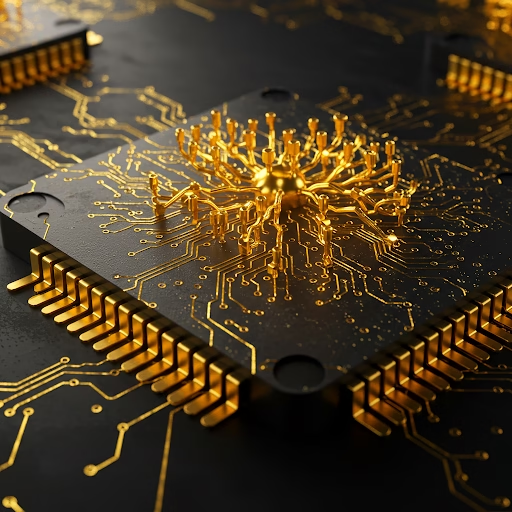
Neuromorphic chips process information like biological neurons, making them highly efficient for AI vision tasks. Unlike traditional AI models that rely on power-hungry GPUs, neuromorphic systems use event-driven processing, activating only when necessary. This drastically reduces energy consumption while maintaining real-time performance.
Ultra-Low Power Consumption – Neuromorphic chips process data with minimal energy, making them ideal for edge AI and IoT devices.
Real-Time Image Processing – These systems detect and analyze visual inputs instantly, ensuring fast decision-making in applications like robotics and surveillance.
Efficient Pattern Recognition – By processing data more like the human brain, neuromorphic AI excels at object detection, motion tracking, and facial recognition with lower computational cost.
Adaptability to Dynamic Environments – Unlike traditional AI models, neuromorphic vision systems adjust to changing conditions, improving performance in autonomous vehicles, drones, and smart cameras.
Why Neuromorphic Computing for Low-Power AI Vision is a Game-Changer
Enables AI in Battery-Powered Devices – Wearables, drones, and smart cameras can leverage AI vision without draining power quickly.
Boosts IoT Efficiency – Smart home systems and industrial IoT devices benefit from instant AI-powered visual insights without needing cloud connectivity.
Reduces Latency & Bandwidth Usage – Processing vision data locally eliminates the need for cloud computing, ensuring faster response times and lower data transmission costs.
The Future of Neuromorphic AI Vision
As neuromorphic computing advances, AI vision systems will become even more energy-efficient, compact, and scalable. Industries like healthcare, security, and autonomous robotics are set to benefit from high-performance, low-power AI vision.
For a deeper dive into neuromorphic AI technology, check out this detailed report on energy-efficient AI.